Big Four (PdS)
dez25
Macau Chief Executive Sam Hou Fai underscores the importance of four new infrastructure projects and two government-led funds in driving the city’s economic diversification in his latest Policy Address, as uncertainty continues to weigh on the local economy
By Tony Lai
MOP236 billion
– Government’s estimate of 2026 gross gaming revenue
The ongoing development of four major infrastructure projects, the launch of two new overseas trade and tourism offices, a sweeping administrative overhaul, and targeted measures to stabilise the struggling property market were among the key highlights of Macau Chief Executive Sam Hou Fai’s second Policy Address.
Much like his inaugural policy blueprint delivered earlier this year, the latest address made only passing reference to Macau’s gaming industry, aside from reiterating the government’s commitment to ensuring its healthy, lawful, and orderly development to support local livelihoods and small-and medium-sized enterprises (SMEs).
“Economic diversification and development have been central themes of my Policy Addresses,” he said during the announcement of the Policy Address for 2026 in November. “We will continue to implement large-scale initiatives across different sectors to diversify the economy beyond gaming, such as the four major infrastructure projects.”
These four cornerstone projects, first unveiled in April, include: the Macau-Hengqin university town, an international integrated tourism and cultural zone, a science and technology industrial park, and the expansion of Macau International Airport with a new cargo terminal in Hengqin.
The University Town project aims to broaden educational opportunities and create more development space for Macau’s higher education sector in Hengqin. According to Mr Sam, the project is being implemented in three phases. The first phase of the project will see the University of Macau, Macau Polytechnic University (MPU), and the Macau University of Tourism (UTM) begin offering postgraduate programmes using existing facilities in Hengqin in September 2026, with an initial intake target of 1,200 students.
The second phase, expected by 2028, involves the completion of a new University of Macau campus in Hengqin. The third phase will focus on the future development of new campuses for MPU and UTM in Hengqin, although no specific timeline has been set for their completion. Upon full completion, the university town project is expected to accommodate up to 20,000 students.
The International Integrated Tourism and Cultural Zone, meanwhile, is being positioned as a flagship cultural hub to support Macau’s diversified economic growth. “The cultural zone will serve as a vital platform for promoting sustainable, high-quality development. It will become a new cultural landmark integrating performances, artistic exchange, tourism, leisure, and commercial facilities,” Mr Sam said.
Public consultation on the zone is ongoing through the end of the year. The current proposal includes three facilities: the Macau National Museum of Culture, the Macau International Centre for Performing Arts, and the International Museum of Contemporary Art. Two development locations have been confirmed: a site adjacent to Macau Tower and New Urban Zone C, one of five newly reclaimed areas off Taipa’s Ocean Gardens.
The National Museum of Culture, planned as the city’s largest museum and spanning 80,000 to 100,000 square metres, is expected to break ground first, with architectural design work starting next year.
No clarity in budget
Macau’s new Science and Technology Industrial Park will focus on four strategic sectors: biomedicine, integrated circuits, digital technology, and aerospace. Public consultation is currently underway until year-end, with the park to be built across two sites: an 83,000-square-metre plot on Avenida Wai Long, opposite the Macau International Airport, and a 177,000-square-metre area on the west bank of New Urban Zone E1.
“We are advancing development planning, including early-stage consultations on industry positioning, layout, and operating models,” Mr Sam noted. “Budgeting and tender processes are being fast-tracked, and we are actively seeking investment and central government support.”
While no completion date has been set, the government has announced the transformation of the former Macau Young Entrepreneur Incubation Centre in the NAPE district into the Macau International Technology Industry Centre next year. This 2,000-square-metre site will serve as a temporary base for both local and overseas tech firms until the park is operational.
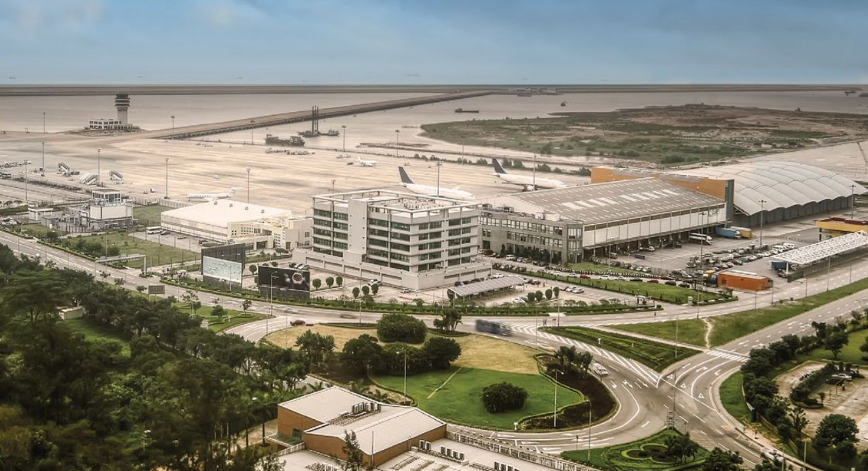
As part of the Pearl River International Air Transport Hub, the expansion of Macau International Airport and the construction of a cargo terminal in Hengqin remain on schedule. “We are working to establish an efficient intermodal transport system between the Macau airport and the Hengqin Cargo Terminal to bolster Macau’s competitiveness in global air logistics,” the chief executive said.
The government previously revealed estimated costs of MOP 20 billion for the university town and MOP12 billion (US$1.5 billion) for the cultural zone. However, no updated total budget for the four infrastructure projects was disclosed in the latest address. The city’s leader simply noted that around MOP20 billion per year is being spent or allocated toward these initiatives.
Beyond infrastructure, Mr Sam also highlighted the planned establishment of two government-backed funds as critical to accelerating economic diversification. “We are moving forward with the creation of a government-led industrial fund and a guiding fund, jointly financed by public and private capital,” he said.
Though he did not provide a timeline or scope, the funds are intended to support projects aligned with Macau’s diversification strategy and foster the growth of key emerging industries. “As long as a project benefits the development of both Macau and Hengqin, the funds will actively seek to invest,” he added.
https://www.macaubusiness.com/big-four/


Comments
Post a Comment